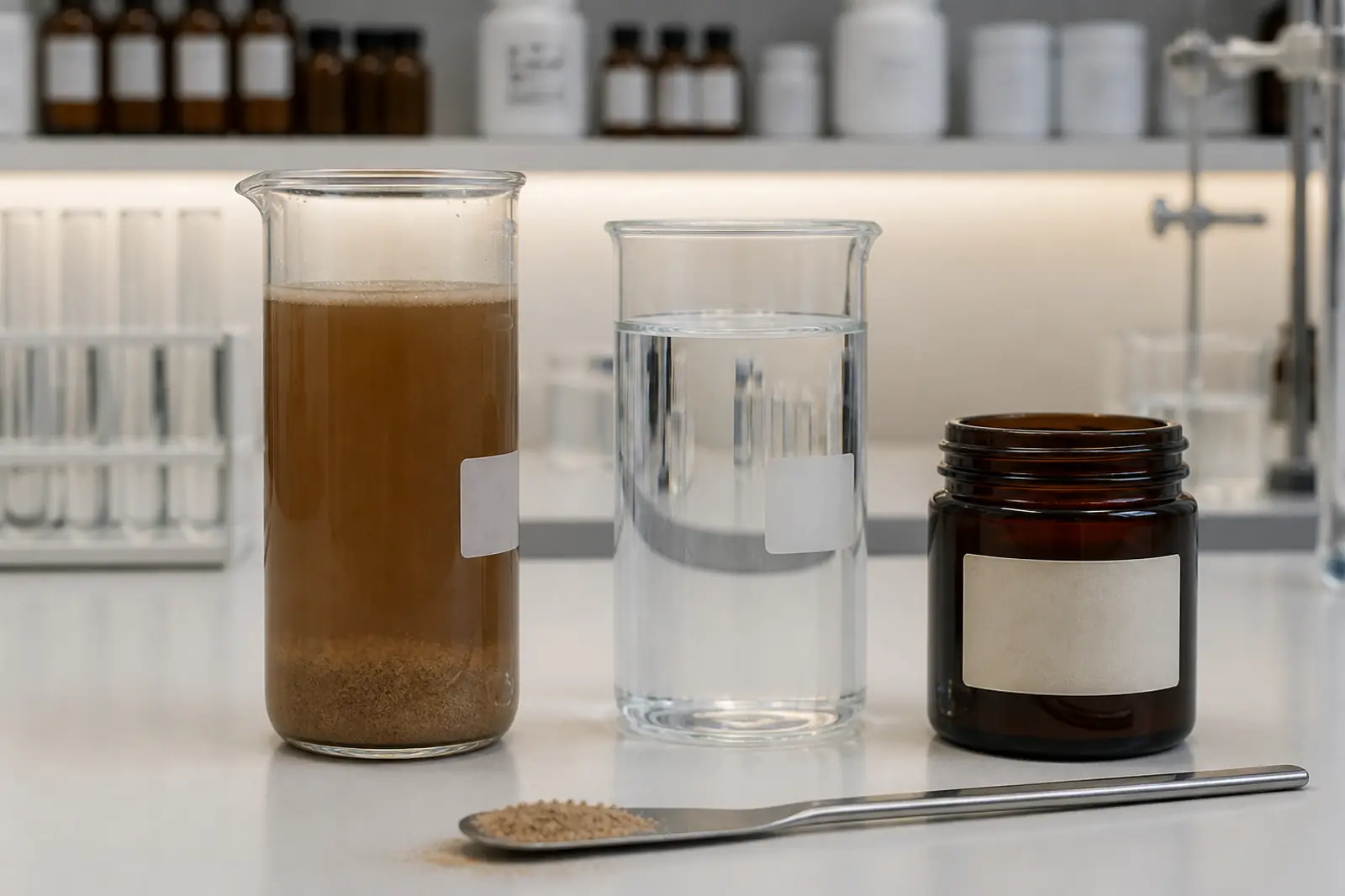
1. Name the defect before you blame the plant
Is it a loose layer that resuspends on shaking, a hard cake, a haze that never settles, or crystals after a pH drop? Photograph against a retained water without powder. If the blank is already opalescent, the extract is cleared. Browse dry botanical extracts as powders with a stated solvent history (water, hydroalcoholic, and so on), not as a single ‘botanical active.’ A seaweed powder and a leaf extract do not fail for the same reason.
2. Incomplete wetting looks like ‘it will not dissolve’
Fine, dusty lots can raft, trap air, and leave specks that later look like precipitation. Predisperse in a side beaker of the actual water (or the polyol the file names) with enough time that the powder is wetted, then merge. Do not sprinkle into a viscous HA gel and call the trapped pockets ‘insoluble extract.’ If the TDS says the material is only partly water-soluble, you were never going to get a crystal toner — you were going to get a suspension that needs a different brief.
3. Two verified powders, two different teaching jobs
A witch-hazel dry extract at kilogram scale is a tannin-leaning leaf/bark story: colour, astringent sensory, and a water-phase that may throw fines. A green-tea dry extract in a small pack is a polyphenol-leaning leaf story: colour leach into a ‘white’ essence is a specification issue, not proof the dose was high. Neither powder is interchangeable with a liquid glycolic cut of the same plant. If the brief needed a liquid, buy a liquid — look at liquid glycolic extracts as a different commercial object rather than forcing the powder to impersonate one.
What buyers say
Buyer experience with this exact Mylo-Opt product. Educational content stays primary — this is not scientific proof.
Open the exact product page — Witch hazel dry extract 1 kgYou can use dry witch hazel extract as a supplement — it works pretty well.
4. Clear after dissolve, cloudy after pH, is a different tree
Polyphenols and some plant acids change solubility when you walk pH. If haze appears only after the acid or the neutralizer, the powder may have been in solution and then crashed. That is not ‘undissolved debris from the start.’ Record pH before and after. Large last-minute corrections are harder to reverse than a water phase designed to land near the extract’s documented window — still without inventing that window here. Filter only after you know whether you are removing debris or removing the material you paid for.
5. Colour and odor are lot checks, not assays
Brown, green, or tea-like odor can be in-spec for that powder and still be unacceptable for a ‘transparent’ SKU. That is a briefing problem. Intensity in a tall beaker is not a quantitative assay of actives. If colour deepens over days while sediment grows, you may have slow extraction from fines plus oxidation. Protect the hydrate from air and light the same way you would protect other oxidisable waters. Do not titrate a serum with your eyes.
6. The hydrate is a water product the moment you add water
A dry powder in a closed jar is not the same as a 10% ‘stock’ you left on the bench overnight. The stock is a water-rich, nutrient-leaning phase. Design the preservation system with that stock and with the finished toner, then challenge the fill — appearance is not microbiology. A preservative that passed a plain gel may struggle after plant solids, sugars, and colour bodies arrive. Do not hold unpreserved extract water ‘to see if it dissolves by morning.’
7. Use the supplier note as a document, not as copy-paste
A technical note on powders in water serums can confirm that a storefront thinks in terms of pre-dissolve and filtration. It does not become MO-LAB’s outline, recipe, or temperature. Your order of operations: identify the defect, read that lot’s TDS, wet the powder as the file allows, distinguish debris from pH crash, decide whether the brief is a true solution or a suspension, preserve the hydrate, keep a retain. If the powder cannot meet a crystal-clear claim, change the claim or change the material.