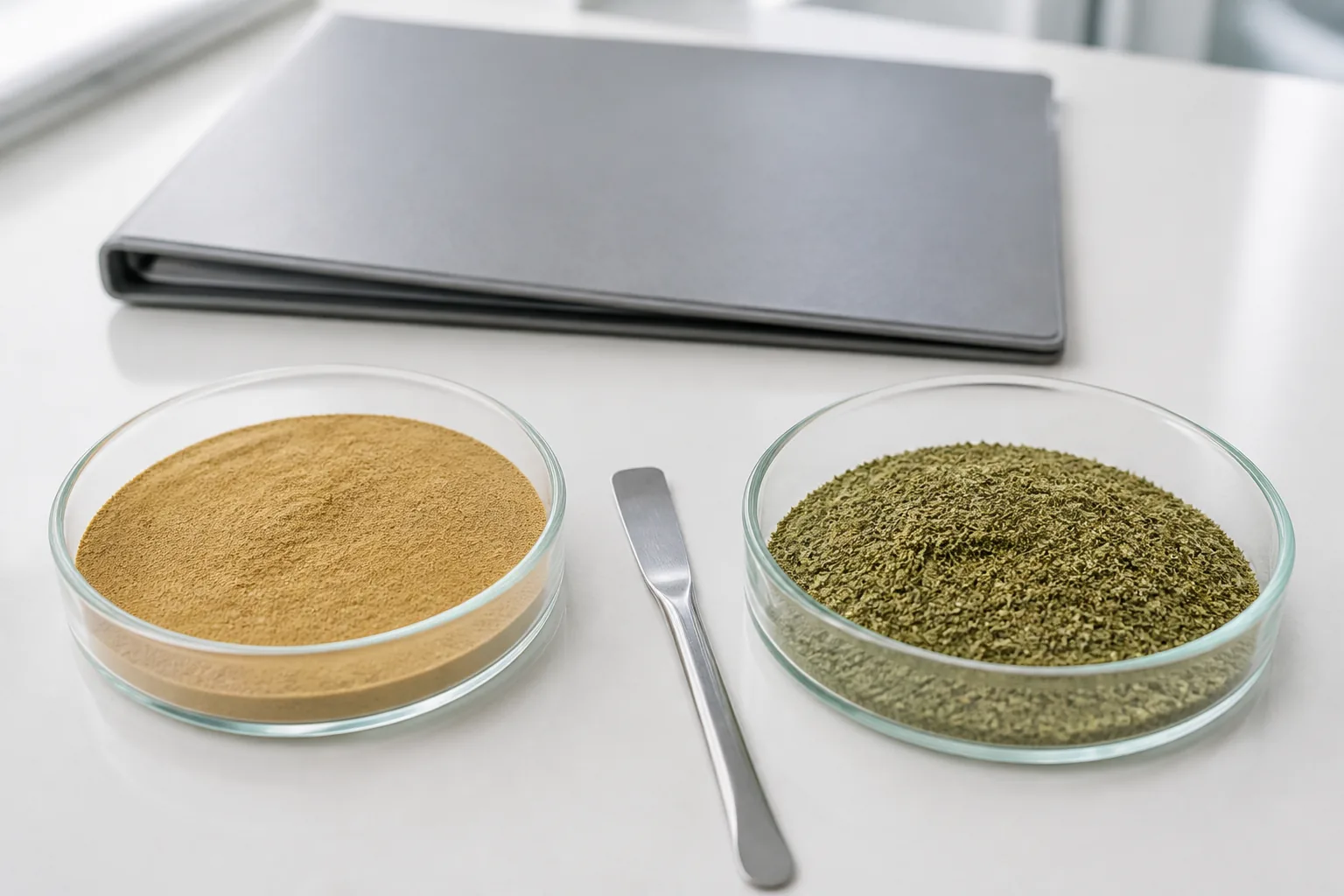
1. Name the commercial object before you name the plant
Write down what you think you bought: dry extract, milled herb, juice powder, or a liquid glycolic cut sold in a different aisle. Browse dry botanical extracts as powders that claim an extraction history, not as a colour chip. The botanical extracts hub is a map of families (dry, hydroglycolic, and others) — use it to see that the same Latin name can be four SKUs. If the PO only said ‘hamamelis powder,’ you have not specified an object. A witch-hazel dry extract at kilogram scale is a documented extract lot. A kitchen grind of leaf is not a smaller pack of the same thing.
What buyers say
Buyer experience with this exact Mylo-Opt product. Educational content stays primary — this is not scientific proof.
Open the exact product page — Witch hazel dry extract 1 kgYou can use dry witch hazel extract as a supplement — it works pretty well.
2. Four fields that appearance cannot replace
INCI, solvent or process history, carrier (maltodextrin, gum, none stated), and any extraction-ratio or native-extract statement. If any of those is missing, you do not invent it from the brown of the powder. A COA that only lists heavy metals and microbiology has not told you the extract identity. A TDS that says ‘partly water-soluble, plant fines expected’ is describing an extract with debris — still not a licence to treat it as ground herb, and not a licence to treat ground herb as that extract. Colour, odor, and particle size are incoming checks. They are not assays of polyphenols and they are not a ratio.
3. Solubility and sediment assumptions follow identity — they do not prove it
A true dry extract may be built to give a workable water or hydroglycolic solution, then still throw fines. Ground plant will wet, swell, and settle because you bought matrix. If you treat the grind as an extract, you will write a ‘clear toner’ brief that was never available and then blame the plant. If you treat an extract as a grind, you may overdose the soluble fraction while filtering off the material you paid for. The sediment diagnostic on this site starts after identity is known. Do not use a ring on the beaker as a substitute for the TDS. A green-tea dry extract in a small pack is a polyphenol-leaning extract story — not a tin of crushed leaf.
4. Dose arithmetic breaks when the object is wrong
Extract ratios, when present, compare starting plant to finished extract solids plus carrier. They are lot language, not a number you copy from a blog onto a different powder. Ground plant is dosed as plant mass. There is no honest conversion between ‘1% leaf powder’ and ‘1% dry extract’ without the file. If the carrier is half the powder, your ‘1% extract’ is not 1% native extract. If there is no ratio on the sheet, you do not have a ratio. Write the use level as mass of the commercial powder and keep the claim inside what that powder is. Do not print ‘10:1 hamamelis’ because the sack was dark.
5. Preservation assumptions change with the object
A closed dry extract jar is low water. The moment you make a hydrate, you have a water product with whatever sugars, colour bodies, and residual plant solids that object contributes. Ground plant hydrates are closer to infusions: more matrix, often more bioburden, different challenge behaviour. Do not copy a preservative system from a glycolic liquid extract onto either powder without treating the hydrate as a new formula. Look at liquid glycolic extracts when the brief actually wanted a preserved liquid cut — that is a different commercial object, not a ‘wet version’ of a mystery brown dust. Appearance of the dry sack does not tell you which hydrate you will get.
6. INCI can rhyme while the goods do not
Two labels can show the same plant name and still be extract versus grind, or extract-plus-carrier versus native cake. Some markets allow a plant powder INCI that does not spell ‘extract.’ Some extract lots lead with the plant and hide the carrier in a second line. Read every line. If purchasing substituted ‘the cheaper hamamelis’ and the INCI changed from extract to leaf powder, you did not save money on the same active — you changed the brief. Keep retains of the powder and of the first hydrate. Photograph is not a specification, but it stops arguments about which sack went into which batch.
7. A buying gate that wastes less powder
Refuse to brief a crystal-clear serum until the object is named. Ask for INCI, process/solvent, carrier, and any ratio on that lot. If the supplier cannot say whether the powder is an extract, do not write extract claims. If it is an extract, then — and only then — use the sediment and wetting tree on the matching diagnostic page. If it is ground plant, rewrite the product as a suspension or a rinse-off and stop promising a toner that behaves like a solution. Identity first. Troubleshooting second. Colour never.