1. This is not the trace-in-water how-to
Open solubilize-fragrance-in-water when the brief is still a few drops in a clear gel. Open solubilizer versus emulsifier when you have not yet named the job. Stay here when a ratio that once cleared the beaker now milks it. Browse the surfactants aisle as documented amphiphiles with use lines — not as infinite ‘clarity insurance.’ If you have not yet made a working trace, you are on the wrong URL.
2. Clock the oil load, then the solubilizer, then the optics
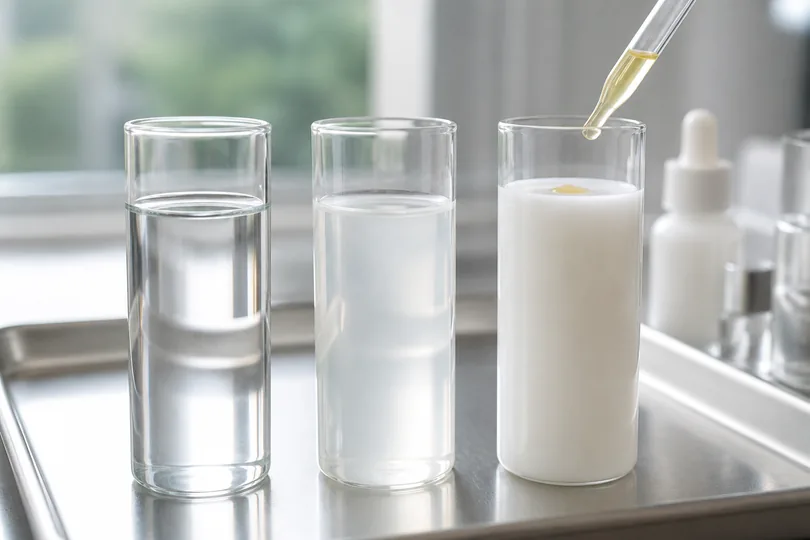
Write the perfume or essential-oil grams, the solubilizer grams, and whether the beaker is water-clear, opalescent, or milky after a rest. If clarity died the moment the oil doubled and the solubilizer stayed put, you have a load problem. If clarity died after you doubled the solubilizer to ‘rescue’ the oil, you may have built a second dispersed phase. Do not invent a universal ratio on this page. The ratio belongs to that pair of lots and that water.
3. Polysorbate 20 is a light-oil tool, not a cream in disguise
Polysorbate 20 is a verified 1 L lot for light fragrance or EO traces in water. It is not a face-cream emulsifier that you can scale until a 2% perfume oil looks elegant. If the toner went milky after you treated it like a cream kettle, you changed the chassis. Read the lot as a water-phase helper. Do not read it as permission to skip an emulsion when the oil load is no longer a trace.
What buyers say
Buyer experience with this exact Mylo-Opt product. Educational content stays primary — this is not scientific proof.
Open the exact product page — Lavender essential oil 10 mlI only use lavender oil inside the cabinets: I made sachets and refresh them now and then with a couple of drops of lavender. That's my moth prevention. The lavender sachets are the favorites in the kitchen cabinets — one on every shelf.
Open the exact product page — Lavender essential oil 10 mlLavender essential oil helped me get rid of dandruff. I'm really pleased. Thank you!
Open the exact product page — Lavender essential oil 10 mlMy esthetician told me to put lavender essential oil in a hair mask.
Open the exact product page — Lavender essential oil 10 mlFor me, lavender essential oil is just a strong anti-stress thing.
4. Polysorbate 80 is the heavier-oil fork — still not an emulsifier rename
Polysorbate 80 is the documented heavier-oil sibling on the same shelf. Switching from 20 to 80 because the leftover oil was thicker can be an honest fork. Pouring both until the beaker is white is not. If 80 clears a small EO premix and the toner still milks after you add a second perfume, you did not pick the ‘wrong tween.’ You stacked two oil loads. Two lots, two files, one optical target: clear, or admit the milk.
5. A leftover lavender is an oil load, not a rounding error
Lavender essential oil left on the bench is still an oil. Adding ‘just the leftover’ to a toner that already has a fragrance is a second load. The essential-oil category exists so you weigh a documented lot, not so you empty a pipette into a clear water that was already at its optical limit. If the leftover is also oxidized, you have a different article. Here the object is grams of oil versus grams of solubilizer versus the claim ‘clear toner.’
6. What you can write without inventing a cream
You can say the working trace ratio failed after the oil grew. You can say the solubilizer dose itself milled the water into a milk. You cannot publish a magic ‘1:4 always clears’ rule. You cannot call a milky toner a gel because the brief promised one. If the load is no longer a trace, the honest next page is an emulsion — and that is a different brief, not a bigger drum of polysorbate.