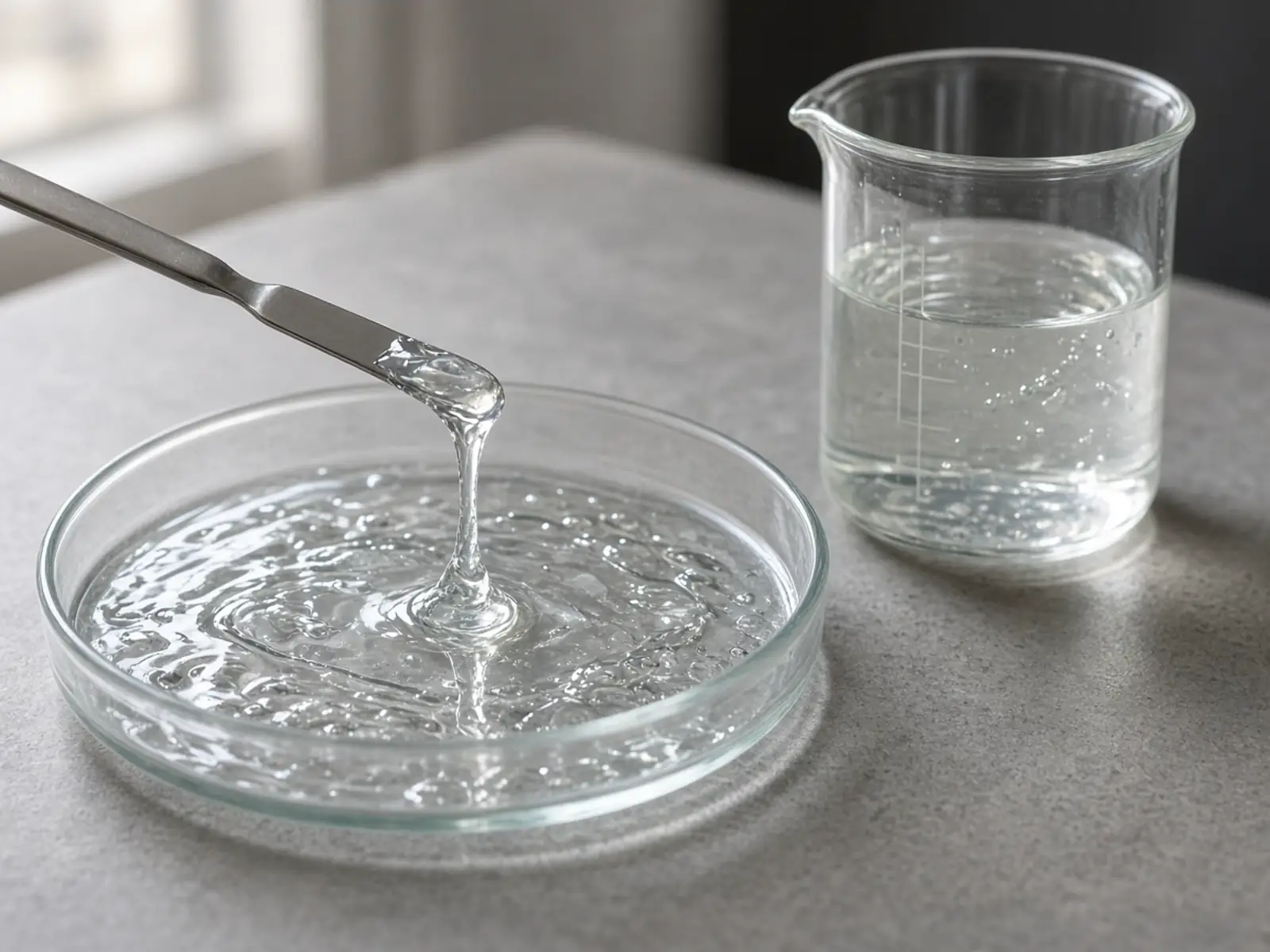
1. If the cup looks normal, do not start at salt shock
A gel that thinned overnight is a rheology failure: electrolytes, un-neutralised slurry, wrong polymer. Browse gel formers and thickeners when the mass itself will not stand. If the mass stands and spreads, and only the dry-down is ugly, you are in sensory load. Adding another acrylate ‘to make it expensive’ often makes the film worse. Keep a retain of today’s viscosity so you do not ‘fix’ a cup that was never the complaint.
2. Hyaluronic fractions are film tools, not one humectant
High-MW hyaluronic acid and a low-MW grade do not leave the same residue. A crosspolymer is a third object. The hydration guide already maps molecular weight as a design choice. Here the complaint is the leftover film when several fractions plus another polymer share one water. If the brief wanted slip and got string, reduce one hyaluronic line per trial — the one the TDS describes as a film former — instead of deleting every water-binding INCI at once. Shop hyaluronic acid actives as named lots, not as ‘some HA.’
3. HEC makes a different dry film than carbomer
Hydroxyethylcellulose is a non-ionic cellulose ether with its own hydration and residue story. It is often picked because salts hurt carbomer. That can be the right fork for viscosity. It is not automatically the right fork for dry-down: some HEC films feel more ‘lotiony’ or more tacky once water is gone, depending on the grade on that TDS. Do not copy a shampoo use-level onto a face serum. Do not stack HEC on a greedy HA film ‘because both are natural-leaning thickeners.’ One polymer change per retain.
4. Glycerin and panthenol are solids after the water leaves
Vegetable glycerin and a D-panthenol concentrate stay behind when the drop evaporates. That is their job as humectants. It is also why a formula that pours like water can dry like syrup. The humectant-blend guide is about assigning roles in the water. This page only asks whether the leftover mass is the tack. Cut one humectant per trial, or cut the applied dose, before you rewrite the polymer. Do not paste a blog’s ‘maximum glycerin %’ — read the lot you bought and the feel of your watch-glass retain.
5. Application amount and the next layer are part of the formula
A two-drop serum that feels elegant can feel like glue at six drops. SPF, a second polymer serum, or a rich cream on top will read that film as pilling or drag. That is not proof the viscometer lied. Reduce the fill, write a smaller use amount, or keep the next product off the trial until the dry-down of this layer is honest. Do not raise the peptide to ‘justify’ a sticky chassis.
6. A retain ladder that does not invent numbers
Keep A: today’s formula. B: one hyaluronic grade removed. C: HEC swapped or reduced per that TDS. D: one humectant reduced. E: same formula, half the applied dose. Score tack at a fixed dry-down time on skin and on glass, plus the cup viscosity so you do not drift into a different failure. If B–E all still grab, the film former is probably still in the room — look at the remaining polymer, not at a folklore vitamin.
7. What you can claim on pack
You can say the serum is designed to dry without a heavy film, if your retain ladder showed that. You cannot say ‘non-sticky because we used HEC’ or ‘glycerin-free therefore elegant’ without the watch glass. You cannot print a universal percentage. You cannot blame the customer’s skin type for a candy film that also shows up on glass.