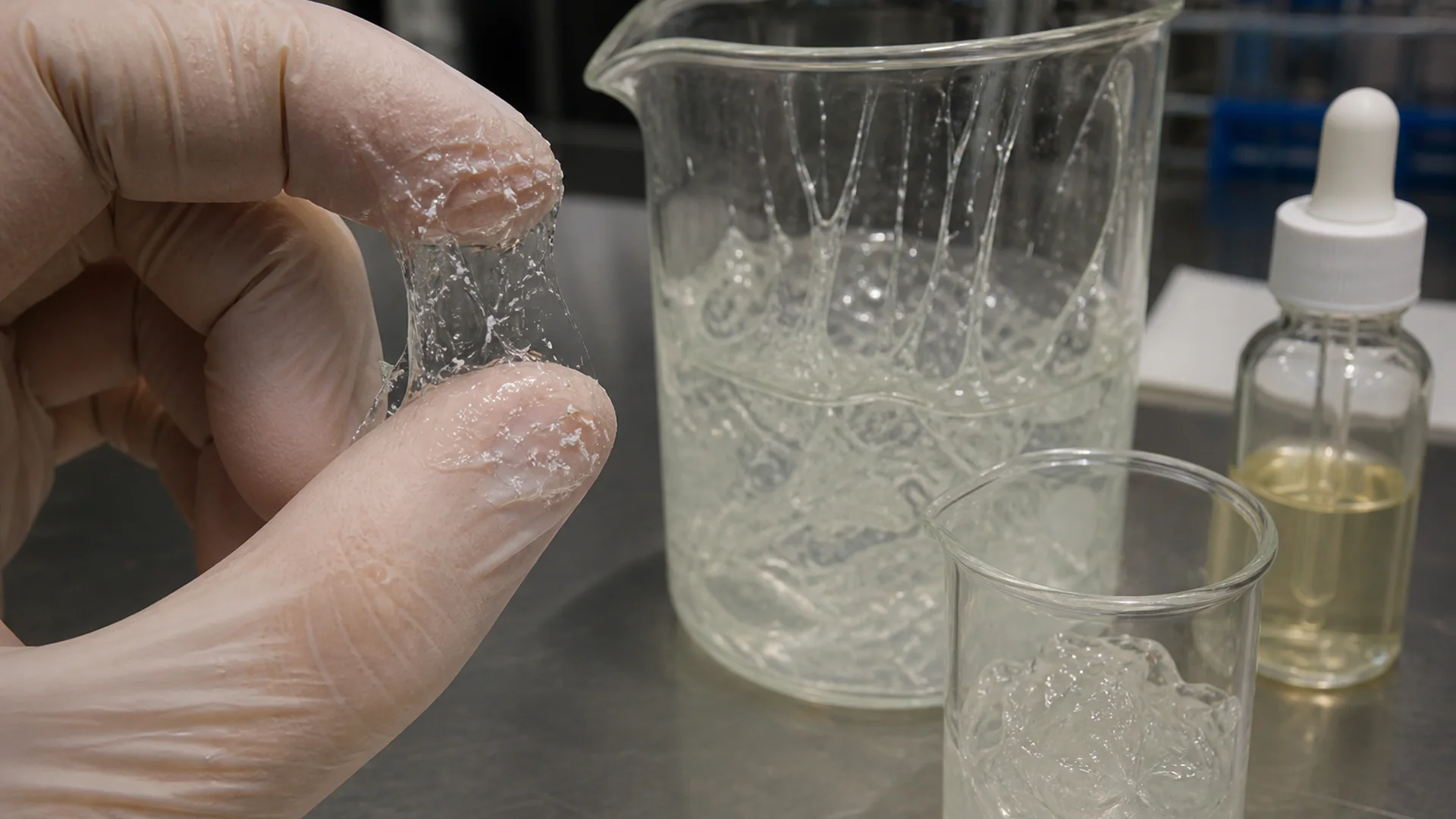
1. Name the failure before you rename the peptide
If crumbs appear while you rub a single product on clean, dry skin, you are looking at the formula’s own film: polymer, high-MW hyaluronic fractions, powders, or a sticky glycol load. If crumbs appear only under sunscreen or makeup, start with the layering diagnostic rather than rewriting the peptide line. Do not assert a universal incompatibility between peptides and niacinamide, or between peptides and SPF, without a controlled comparison. Timestamp the defect. Photograph. Keep a retained batch.
2. Film formers and gel networks fail in their own language
Electrolyte-sensitive acrylate networks (the family DIY logs often call Sepimax-class, among others) can string, shrink, or release a watery serum when ionic load climbs. That is a polymer story. The peptide sequence is usually a passenger. Check the thickener’s own TDS for salt and solvent limits before you accuse Acetyl Hexapeptide-8 of pilling. Gelling agents and thickeners are chosen for the full aqueous load, not for a water-only mock-up. Overloading two film formers “for luxury” is a common way to make crumbs without any peptide at all.
3. The peptide solution can be a salt-and-solvent delivery, not a villain
Commercial liquids bring buffers, counter-ions and glycols. Those passengers can collapse a fragile carbomer or shock an acrylate gel that looked elegant in purified water. An Argireline concentrate is a documented liquid: its carrier enters the formula at whatever mass you add. Compare the same gel with an equivalent solvent/electrolyte challenge if the file allows, versus swapping the peptide brand as the first move. If viscosity dies in the beaker, that is the gel-thinning tree, not proof the peptide “curdled.”
What buyers say
Buyer experience with this exact Mylo-Opt product. Educational content stays primary — this is not scientific proof.
Open the exact product page — Low-MW hyaluronic acid 1 kgWe only buy low-molecular hyaluronic acid from you. Quality matters for the cosmetics we make.
Open the exact product page — Low-MW hyaluronic acid 1 kgLow-molecular hyaluronic acid works for our higher-end cosmetics. Quality is high, prices are reasonable. Thank you!
Open the exact product page — Carbomer 1 kgBought carbomer to make a shower gel. Followed the instructions. The carbomer thickened the water phase nicely. I'd shop here again.
Open the exact product page — Xanthan gum 1 kgShampoo recipe: I cool a soap-nut decoction (around 300 ml), add a teaspoon of baking soda, dissolve essential oils in polysorbate 20 (I like citrus and mint — hair stays clean longer), mix that into the decoction and add a pinch of xanthan gum. I whip it with a regular immersion blender, not a little cream mixer. The longer I blend, the thicker the shampoo. It keeps in the fridge for two weeks.
4. Tack after dry-down is often glycerin, HA or leftover film — not the sequence
A serum can feel elegant wet and grabby after water leaves. Glycerin-heavy chassis, some hyaluronic fractions, and incomplete polymer hydration all do this. Low-molecular-weight hyaluronic acid is a different sensory tool from a high-film grade; using both plus a peptide glycol blend can produce stringing that gets blamed on “peptides.” Reduce one humectant or one polymer per trial. Tack is not microbiological failure. Tack is also not proof you should delete the active.
5. Carriers and application amount finish the diagnosis
A Matrixyl Synthe'6 grade has its own handling notes; a water-light Argireline liquid has others. Neither instructs you to apply a half-millilitre blob and immediately add SPF. Over-application turns even a well-built gel into pills because the film never dries. If the same formula behaves on a controlled forearm dose and fails only in a three-layer routine, write the usage line — do not first rip out the peptide.
6. When the polymer family is the wrong roommate
If an acrylate gel loses body the moment the peptide phase goes in, the TDS may be telling you the network is salt-limited. Some workshops move to a more electrolyte-tolerant gum. Xanthan gum is one documented option with its own sensory tax (string, haze, delayed hydration). It is not a magic anti-pill powder. Hydrate it in the water phase as the supplier specifies; dumping it into a finished peptide serum “to catch crumbs” creates a second defect.
7. A bench order that keeps the peptide innocent until proven otherwise
Base without peptide. Base plus carrier/solvents only, if you can reconstruct them. Base plus the real peptide lot. Same dose on skin, timed dry-down, then one layering partner. Change one variable. If the peptide-free controls already pill or tack, the sequence is cleared. If only the full formula fails, read the peptide file for salts and solvents before you rewrite the INCI story. Supplier TDS still controls polymer and electrolyte limits — not a forum rule of thumb.