1. Stop the cart at the plant nickname
If the purchase order already says ‘green tea extract’ and nothing else, the experiment was designed in the shop. Open the botanical extract aisle as a set of forms, not as a herb catalogue. Write the chassis first: clear water, cream, or anhydrous. Then ask which commercial object can live there. A plant name is a search hint. It is not a specification.
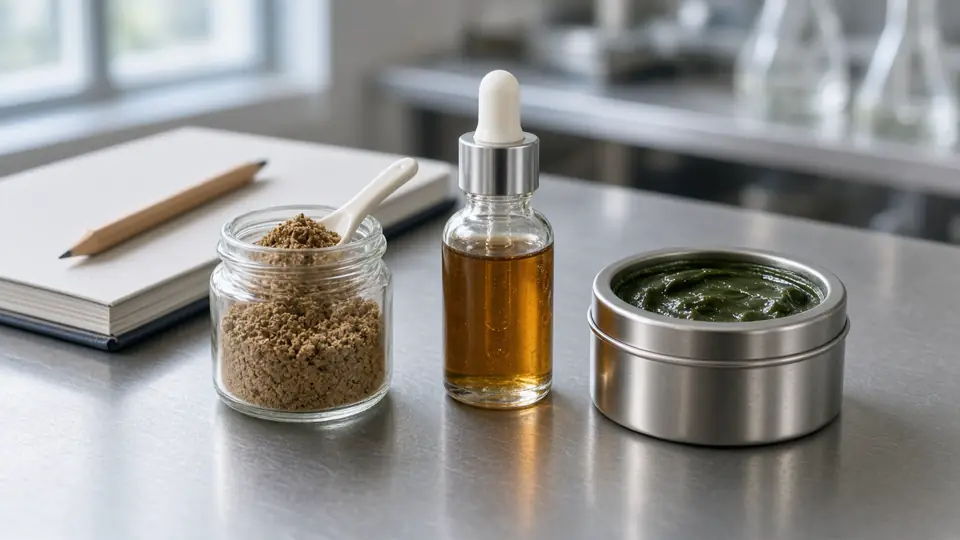
2. Name three objects, not one ‘extract’
A dry botanical extract is usually a powder or granulate with a documented carrier and a solubility line. A glycolic or hydroalcoholic extract is already a liquid: water, glycol, alcohol, or a mix — that solvent becomes part of your formula the moment you pour it. A CO2 cut is typically a lipophilic paste or oil-soluble concentrate. They can share a plant story and still refuse the same beaker. Do not treat a witch-hazel dry extract as interchangeable with a liquid cut of the same plant, and do not treat a green-tea dry extract as a stand-in for a CO2 smear.
What buyers say
Buyer experience with this exact Mylo-Opt product. Educational content stays primary — this is not scientific proof.
Open the exact product page — Witch hazel dry extract 1 kgYou can use dry witch hazel extract as a supplement — it works pretty well.
3. The useful fields are INCI, solvent, phase, appearance
Copy from this lot’s TDS/COA: INCI, recommended use form, solvent or carrier, solubility or dispersibility, suggested phase, and appearance of the incoming goods. If the file is silent on phase, you do not invent one from a blog. If the file lists a solvent, that solvent is a passenger — it counts in water, in preservation planning, and in odour. Do not paste a storefront ‘CO2 versus dry’ outline into the lab book. Those pages confirm a SKU exists. They do not write your brief.
4. Match the form to the chassis, then buy
A clear toner that must stay optically clean usually wants a documented water-compatible liquid or a dry powder whose file actually promises a solution — not a CO2 paste dumped through a solubilizer ‘to make it natural’. A cream can take a lipophilic CO2 cut in the oil phase if the emulsifier load was written for that oil. An anhydrous balm is a different brief again. If the brand wants the plant story in a water gel and the only honest lot is oil-dispersible, change the chassis or change the lot. Do not change the physics with a slogan.
5. Do not reopen sediment, grind identity, or phase-after-purchase
If the powder already arrived and then sank, that is the sediment article. If purchasing received milled herb labelled as extract, that is the identity article. If the file is already in hand and the fight is water versus oil, that page exists. Here the only question is which form to requisition. Swapping forms after a stability pull has started is a new batch, not a tweak.
6. A retain is one form, one chassis
Build the chassis once. Do not ‘compare’ a dry lot and a CO2 lot in the same water and call the haze a quality failure of the plant. They were never the same input. If you need a plant story in two chassis, write two products. Read the CO2-versus-dry extract note only to confirm which SKU families exist — then return to this lot’s fields.
7. What honest copy can say
You can say the brief named a chassis, three commercial forms were considered, and the chosen lot’s INCI, solvent and phase were copied from that file. You cannot say a dry powder is ‘stronger’ than a CO2 cut, or that glycolic liquids are automatically preserved by their solvent. You cannot invent a universal plant-to-extract ratio. If the brand wants one plant name on two textures, that is two specifications.