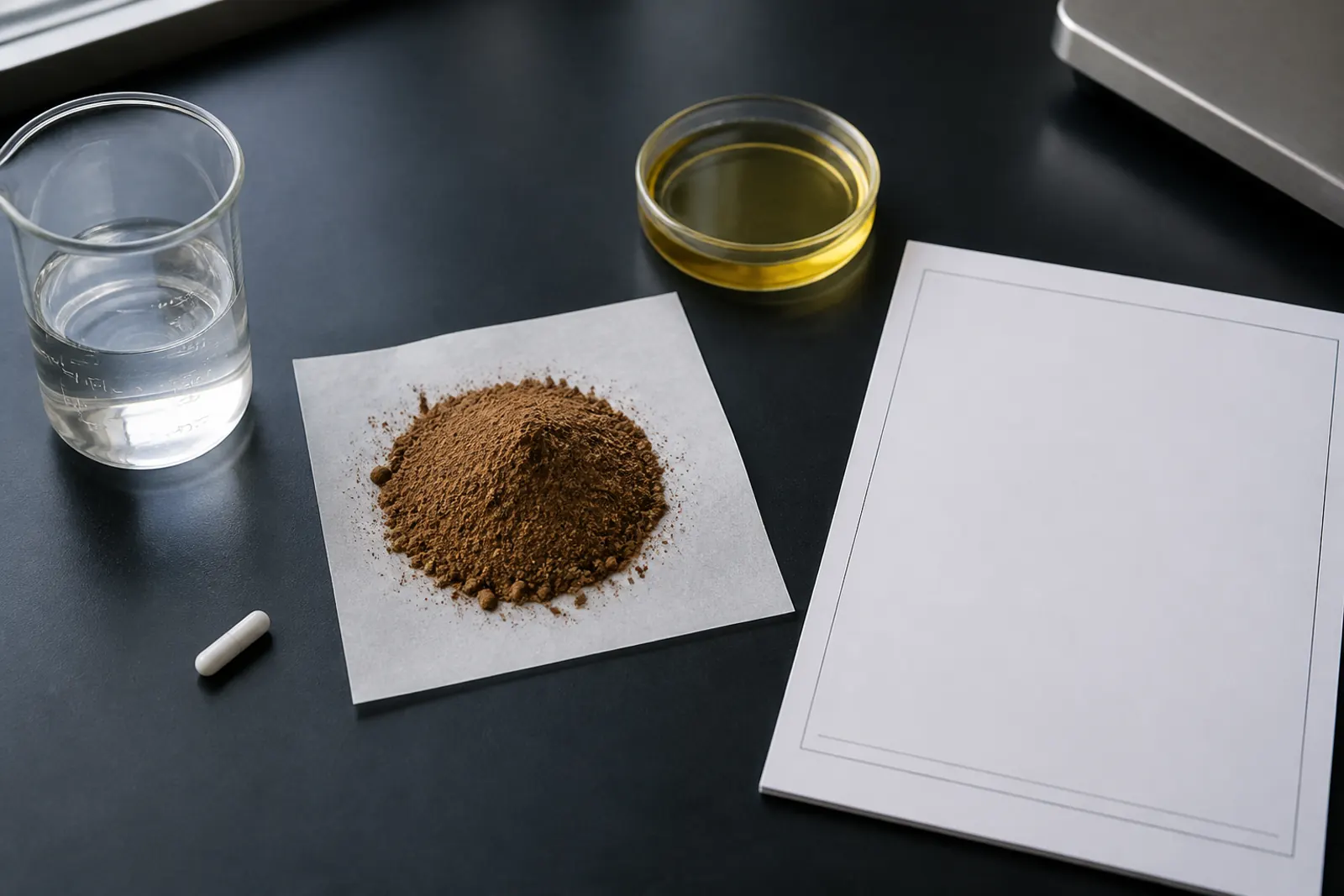
1. Open the sheet before you open the sack
Look for solvent history, solubility in water or oil, a carrier (maltodextrin, gum, oil, none), and any sentence that names a phase. Browse dry botanical extracts as powders with those fields, not as a plant name you already decided to ‘put in the cream.’ If the sheet only describes a water-wettable powder, the oil phase is not a workaround. If the sheet is silent, you do not have a phase. You have a purchasing question.
2. A water-wettable tannin lot is not an oil-phase pigment
A witch-hazel dry extract at kilogram scale is a useful teaching lot because leaf/tannin stories are usually written for water or hydroglycolic systems. Colouring an oil does not mean the extract dissolved in the triglyceride. It may mean fines are suspended, or a carrier dyed the lipid. That is not a licence to call the cream ‘oil-soluble hamamelis.’ If the brief needed an oil-phase botanical, you may need a different commercial object — a CO2 or an oil-macerate with its own file — not a forced powder.
What buyers say
Buyer experience with this exact Mylo-Opt product. Educational content stays primary — this is not scientific proof.
Open the exact product page — Witch hazel dry extract 1 kgYou can use dry witch hazel extract as a supplement — it works pretty well.
3. Polyphenol powders still have a solvent sentence
A green-tea dry extract in a small pack can stain water fast and still be a water-side material. Do not move it to oil to ‘keep the toner clear.’ That is how workshops create a brown ring in the lipid and then write a sediment complaint that belongs on another page. If the file names a glycol carrier or a water solubility window, stay there. Tint is not proof you chose the correct phase. It is a specification check against the lot.
4. When the water brief cannot live with a powder, buy a liquid water object
If the toner must stay a true solution and the powder’s file only promised a wettable hydrate, stop arguing with the sack. Look at liquid glycolic extracts as a different water-phase object: solvents, solids, preservation already in the liquid. That is not ‘the same plant, wet.’ It is a new PO. Switching after three failed oil-phase experiments is cheaper than rewriting the claim around a powder that was never an oil solute.
5. The Latin name is a map of objects, not a phase
Dry, hydroglycolic, and other families sit under one plant. Use the botanical extracts hub as a map of commercial objects, then read the phase field on the object you actually bought. Chassis selection among extract families (dry vs CO2 vs liquid as a strategy) is a later, storefront-adjacent question this wave is not republishing. Today’s job is narrower: once the object is this dry powder, which phase does its specification allow?
6. Wetting instructions are not a licence to change phase
Read powdered-extract handling notes as a supplier process document for the named solvent. Predisperse in the solvent the sheet allows. Do not ‘improve’ a water-wettable powder by slurrying it in oil because a neighbour did that with a different INCI. Do not copy a storefront how-to into the batch sheet. If particles remain after an honest water hydrate, you may have a dispersion — that is the optical-target page — or you may have the wrong object for a solution brief. You do not automatically have an oil-phase product.
7. A phase line before anyone weighs the powder
Solvent named on the TDS. Carrier named on the TDS. Allowed phase (water / oil / either / silent). What happens if you ignore that line. What the label will be allowed to say. Which retain you will keep: powder, water hydrate, oil slurry if you even ran one, finished fill. If the phase cell is silent, do not invent a side to look decisive. Identity of extract versus ground plant is earlier. Optical solution versus dispersion is later. Sediment after a failed hydrate is later still. Do not collapse the four jobs into one complaint about ‘the brown powder in the cream.’