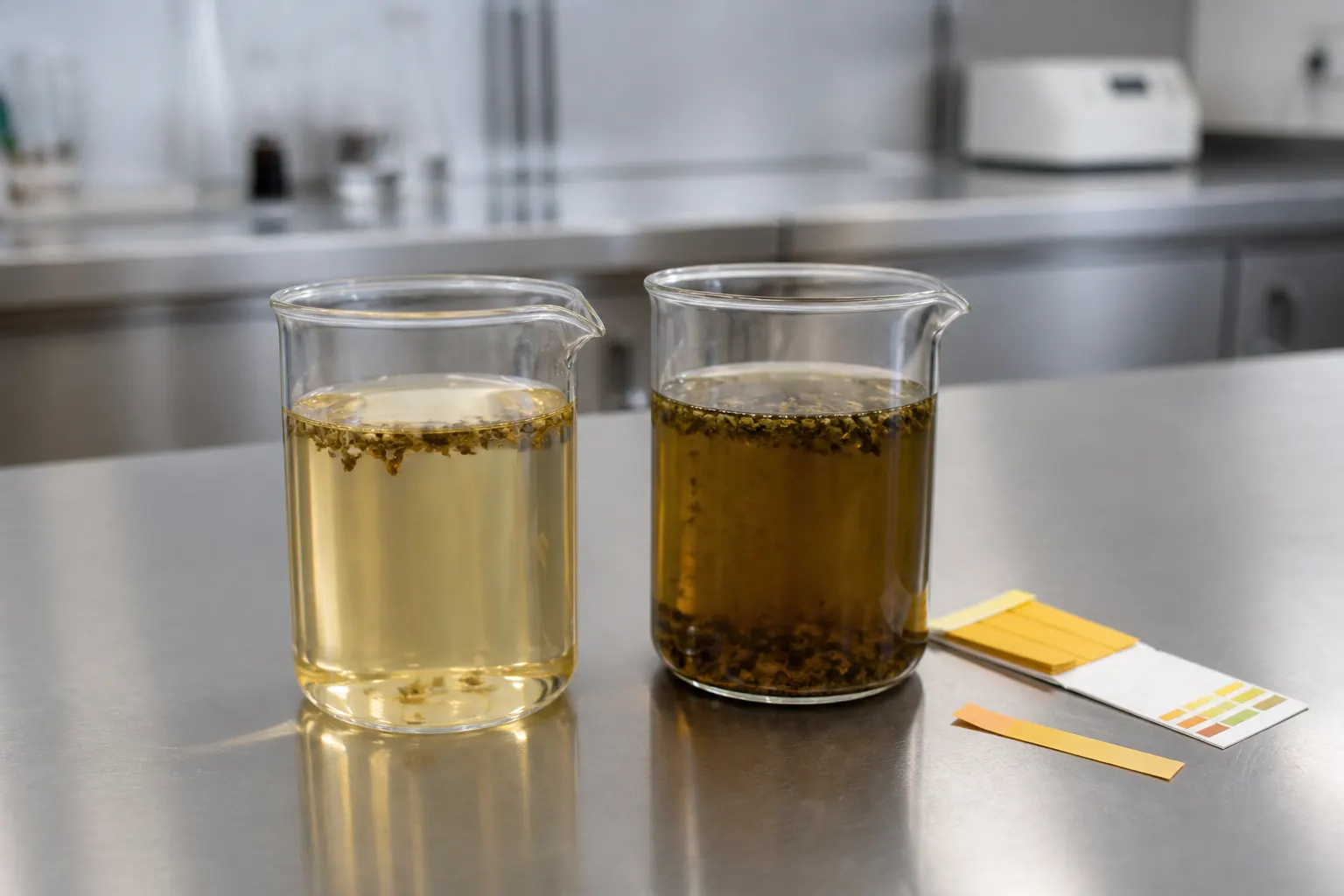
1. Start the clock after the liquid already went quiet
Write the day the hydrate first looked finished: no grit on the glass, no new cake overnight, the spatula coming out clean. Then write the day the colour or the odor walked. Browse documented dry-extract lots as powders with appearance, pH preference and storage lines — not as a brown sack that ‘should stay the colour of tea you liked on Tuesday.’ If particles are raining now, you left this page and opened the sediment file. If you never knew whether the sack was an extract, that is identity work. If you still have not chosen a phase, that is the specification page. Here the liquid already cleared, and then the week edited it.
2. A polyphenol water is allowed to walk without becoming a sediment complaint
A green-tea dry extract in water can sit optically quiet on day one and still drift toward amber or brick when the pH moves, when the bottle lives on a sunny sill, or when a carbon-steel spoon stayed in the beaker. That walk is a chemistry of the dissolved load, not proof that ‘nothing dissolved’ and not proof that the powder was ground leaf. Do not ‘correct’ the colour with a random acid at the end of the week and call it a specification. Measure pH when it was quiet and when it walked. Photograph both against the retain. Lot-to-lot polyphenol load is a file question, not a marketing story about ‘stronger tea.’
What buyers say
Buyer experience with this exact Mylo-Opt product. Educational content stays primary — this is not scientific proof.
Open the exact product page — Witch hazel dry extract 1 kgYou can use dry witch hazel extract as a supplement — it works pretty well.
3. A tannin lot has its own week, not the tea week copied over
A witch-hazel dry extract can clear in a polar hydrate and still move toward a duller brown or a sharper leaf odor after days. Copying the green-tea notes onto this lot is how workshops invent a single ‘botanical darkening’ myth. Different plant, different lot, different metal sensitivity. If the brief needed a water that stays the colour of the fill day, write that as a specification and keep the bottle off the window. If marketing already printed ‘never changes colour,’ purchasing must buy a lot whose file can survive that sentence — or marketing must rewrite. Do not chase a floating speck that is not there.
4. A liquid glycolic object is a different clock, not melted powder
When the water brief cannot live with a powder that walks, people grab glycolic liquid extracts and expect the week to freeze. It does not freeze. The solvent chassis, the solids, the already-present preservation story — those change the rate, not the fact that colour can still move. The liquid is a new PO, not ‘the same plant, already well-behaved.’ Use it when you wanted a documented polar object with its own appearance line. Do not use it as proof the dry lot was dishonest because Tuesday was pale and Friday was not.
5. The Latin name is a map of clocks, not one colour promise
Dry, glycolic and other families sit under one plant and do not share a week. Walk the botanical-extract hub as a map of commercial objects, then open the appearance and storage lines on the object you actually hydrated. The hub will not tell you why Tuesday’s water is Friday’s brick. The lot will, if those fields exist. Chassis strategy among extract families is a later, storefront-adjacent question this leftover slice is not republishing. Today’s job is narrower: the powder already went in, the liquid already cleared, and the colour still walked.
6. Serum handling notes are a destination, not a paste source
Read notes on dry extracts in serums as a supplier process address for wetting and for the named solvent — not as an essay to paraphrase into the batch sheet. They can remind you that a water chassis is a real commercial conversation. They do not licence a claim that the hydrate will keep Tuesday’s colour. They do not replace a pH log. If the serum brief needs a true optical solution, that question was already asked on another URL. If particles appear after a week, that is sediment. If only the hue moved, stay here.
7. What the journal can say after a quiet liquid walked
You can say the hydrate was optically quiet on the fill day and the colour or odor changed later. You can say pH, light or a metal tool moved. You can say two lots of the same INCI did not walk the same way. You cannot print an activity percentage because the water darkened. You cannot call the walk ‘proof it is working.’ You cannot invent a use level to stop a polyphenol from being a polyphenol. Keep retains of powder, of day-zero hydrate, and of the week-later bottle. Identity, phase assignment and sediment diagnosis stay on their own pages. This page ends when the week is written honestly.