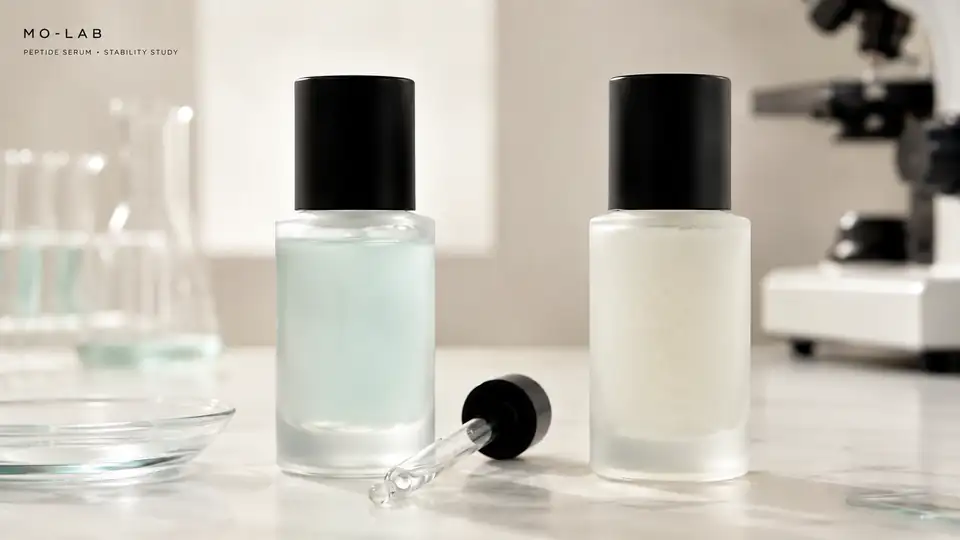
1. Start with the supplied raw material, not the peptide name
Commercial cosmetic peptides rarely arrive as a naked molecule. They may be delivered in water, glycols, buffers or multi-component blends, and those carriers become part of your formula the moment the active is added. Two products sold around the same peptide, such as a SNAP-8 concentrate versus another sequence, can therefore behave differently in an otherwise identical serum. Before troubleshooting, read the supplier INCI, solvent system, appearance specification and storage guidance. Note whether the material is already preserved, whether salts or buffers are present, and whether the supplier specifies a preferred processing stage. This prevents a common mistake: changing the serum base repeatedly while ignoring the chemistry entering with the active itself.
What buyers say
Buyer experience with this exact Mylo-Opt product. Educational content stays primary — this is not scientific proof.
Open the exact product page — Low-MW hyaluronic acid 1 kgWe only buy low-molecular hyaluronic acid from you. Quality matters for the cosmetics we make.
Open the exact product page — Low-MW hyaluronic acid 1 kgLow-molecular hyaluronic acid works for our higher-end cosmetics. Quality is high, prices are reasonable. Thank you!
2. Heat history matters even when the finished serum is cold
A formula can be described as cold-process and still expose a sensitive active to damaging conditions. A hot polymer solution may not have fully cooled, a premix may sit beside heated equipment, or an operator may add the peptide early to save time. Treat temperature as a history, not a single final reading. Build the base, complete any steps that genuinely require heat, allow the batch to reach the supplier-approved addition condition, then introduce the active with controlled mixing. Avoid assuming that more mixing energy is always better. Once the peptide phase is uniform, unnecessary shear can create foam, entrain air or complicate the visual assessment of clarity.
3. pH is an ecosystem, not a number written at the end
Peptide stability is often discussed as if one universal pH window existed. It does not. The relevant window belongs to the specific peptide raw material and the complete formula around it. Acids, neutralizers, botanical extracts, salts and preservative components can all shift the environment. Measure pH after the major aqueous components are combined, again after the active is introduced, and again after the batch has equilibrated. Large last-minute corrections are harder to control than a base designed to land close to target. When a serum becomes hazy immediately after pH adjustment, investigate the neutralizer, ionic load and polymer response before concluding that the peptide precipitated.
4. Preservation can change clarity, viscosity and peptide surroundings
The preservative is not an invisible safety switch. It is a functional ingredient system with solvents, pH preferences and compatibility limits. A preservative that performs well in a simple humectant gel may behave differently after a peptide blend, botanical extract or electrolyte-rich active is added. Some systems alter polymer hydration; others add their own solvent load or require a particular formula environment. Design preservation alongside the active package rather than after the serum is already finished. Supplier compatibility data and appropriate microbiological validation remain the reference. Cosmetic elegance is not proof of preservation, and a strong preservative claim on a raw-material brochure is not a substitute for testing the finished product.
5. Cloudiness is evidence — but it is not a diagnosis
A formerly clear serum can turn opalescent for many reasons: incomplete polymer hydration, fragrance or oil contamination, an overloaded solubilizer system, salts interacting with a thickener, a raw material outside its solubility conditions, or simple air entrainment. Record when the haze appears. If it starts before the peptide is added, the peptide is cleared immediately. If it appears only after a particular premix, test that premix separately in a small amount of base. If the serum clears after standing, trapped microbubbles may be involved. If haze increases over days, examine slow interactions and temperature sensitivity. A controlled sequence of small bench comparisons is far more informative than changing five ingredients at once.
6. The thickener can be the hidden weak point
Peptide serums are often designed to feel weightless, which encourages low-polymer, transparent systems. Those systems can be sensitive to electrolytes and solvent changes, including light hyaluronic-acid gels. A peptide blend that contributes salts or glycols may reduce viscosity even though the peptide itself remains fully dissolved. When viscosity collapses, compare the same base with the carrier system or a simplified electrolyte challenge if supplier information permits. Consider whether the rheology technology is appropriate for the full ingredient load. The goal is not to force a fashionable active into a fragile gel; it is to build a chassis that remains predictable after every real raw material is present.
7. Packaging and oxygen exposure finish the stability story
A batch that looks excellent on day one can still drift in the package. Repeated air exchange, headspace, light exposure and contamination at the dispenser can change appearance and odor over time. Choose packaging only after considering formula sensitivity and consumer use. Airless formats may reduce repeated exposure for some products, while an appropriate pump can also improve dose consistency. Packaging cannot rescue a chemically incompatible formula, but poor packaging can make a good one look unstable. Evaluate the filled product, not only a beaker kept in the laboratory.
A better troubleshooting workflow
Keep a retained control and change one variable at a time. Photograph samples under the same light, record pH and appearance after processing and again after rest, and compare the base before and after each high-impact raw material. Separate questions: Is the peptide raw material within specification? Is the base stable without it? Does the carrier alter rheology? Does pH move after addition? Does the preservative remain suitable? This discipline turns “the peptide ruined my serum” into a traceable formulation problem. In most cases, that is where the useful answer lives.