1. This is not the serum-preservative shopping page
Open the serum preservation guide when you have not yet locked a family. Open the cream page when the chassis is an emulsion. Open challenge-test versus selection when the fight is a certificate versus an INCI. Stay here when a system already sat in a water mock-up and then the finished pH moved. Browse the preservatives and antioxidants aisle as documented systems with pH lines — not as a slogan shelf. If you still need a first pick, you are on the wrong URL.
2. Clock the meter after neutralization, not before the polymer
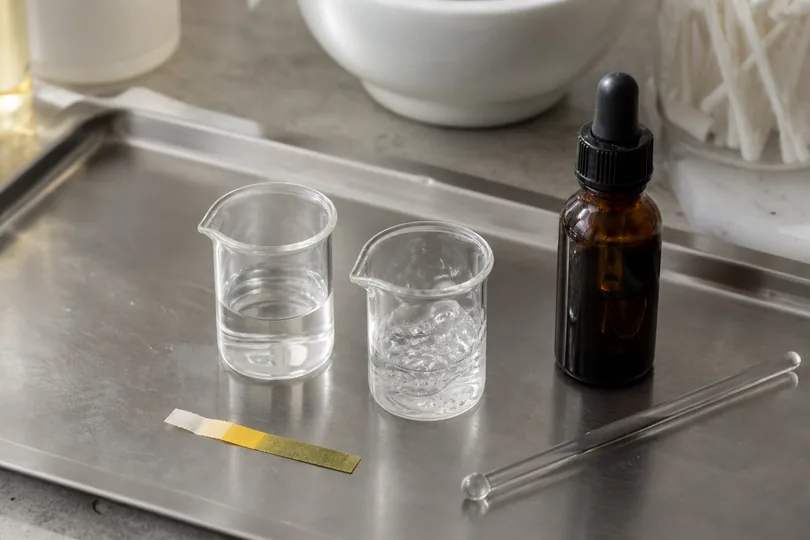
Write three readings: water mock-up, after the polymer is neutralized, after the last concentrate. If the system passed a sketch at 5.0 and the filled gel sits at 6.4, you did not discover a ‘weak preservative.’ You left the window. Do not invent a universal band on this page. The band belongs to that lot’s TDS. A last-minute acid dump to ‘put it back’ can haze a gel or crash an organic-acid story the other way. The useful comparison is the same chassis with and without the neutralization step.
3. Organic-acid stories want the finished acid, not the brochure acid
Organic-acid blends are often chosen because a water mock-up looked comfortably low. After alkali hits a carbomer, that comfort can vanish. The file may still list the same INCI. The environment is no longer the one you validated. Do not ‘fix’ it by adding more of the same acid into a polymer that already hates a local pH crater. Rebuild the base so the neutralized gel lands near the window, then confirm the reading after every real raw material is present.
4. A phenoxyethanol pair is not immune to the walk either
Phenoxyethanol is often treated as the adult in the room. It still has a documented band, and it still sits in a solvent system. Pairing it with ethylhexylglycerin does not freeze the meter. If the brief later wants a low-pH acid leave-on, that pair can be the one that walked out of its own file. Read both lots as a system, not as two independent insurance policies. Do not paste a ‘peptide-safe’ slogan from a blog onto either drum.
5. A complete system is a contrast object, not a mandate
Cosgard preservative is a documented complete system on this storefront. Use it in the argument as a contrast: a named blend with its own pH and use-level file, versus a multifunctional booster sold as if it were the whole plan. It is not automatically kinder, and it is not automatically the answer after every neutralization. If you choose it, choose it for the finished pH you will actually fill — not for the mock-up you liked on Monday.
6. What the peptide-preservation notes are for — and not for
Notes on preserving peptide cosmetics can confirm that a water-rich, nutritive chassis is not glycerin water. They are not a sentence you may paste into a MO-LAB page, and they are not a substitute for the finished-pH walk. If a concentrate moved the meter, write that in the batch record. You may say the mock-up pH is not the filled pH. You may not invent a challenge result or a ‘safe for all peptides’ line. The shopping list and the challenge-theory pages stay on their own URLs.