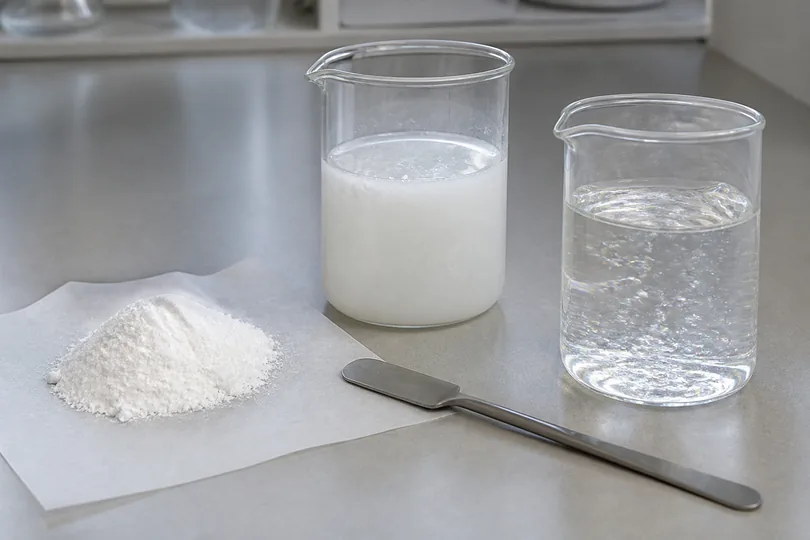
1. Start with the exact material
The cosmetic actives aisle contains materials with very different solubility profiles. Magnesium ascorbyl phosphate is a specific vitamin C derivative, so begin with the supplier documentation for your MAP vitamin C raw material. Record the supplied grade, water quality, addition order and temperature. Do not transfer a rule from ascorbic acid to MAP just because both are called vitamin C. A clear concentrate is not proof that the final serum will remain clear after every other ingredient arrives.
2. Check the finished water phase
Measure the finished pH and compare a control without the newest electrolyte-rich addition. Salts, buffers, botanical extracts and other ionic actives can change the environment even when every ingredient dissolved separately. If haze appears only after one addition, reproduce that step in a small split batch. Change one variable at a time, record appearance immediately and after equilibration, and avoid rescuing the formula by blindly adding solvent.
3. Separate dissolution from stability
A dissolved active can still face a stability problem, while visible crystals can be a solubility or process problem rather than oxidation. Use the active stability formulation notes to keep those diagnoses separate. Photograph the same sample at fixed intervals, record pH, temperature history, color and sediment, and compare against a control. Supplier guidance defines the starting operating window; finished-product stability work determines whether your actual serum and packaging are defensible.