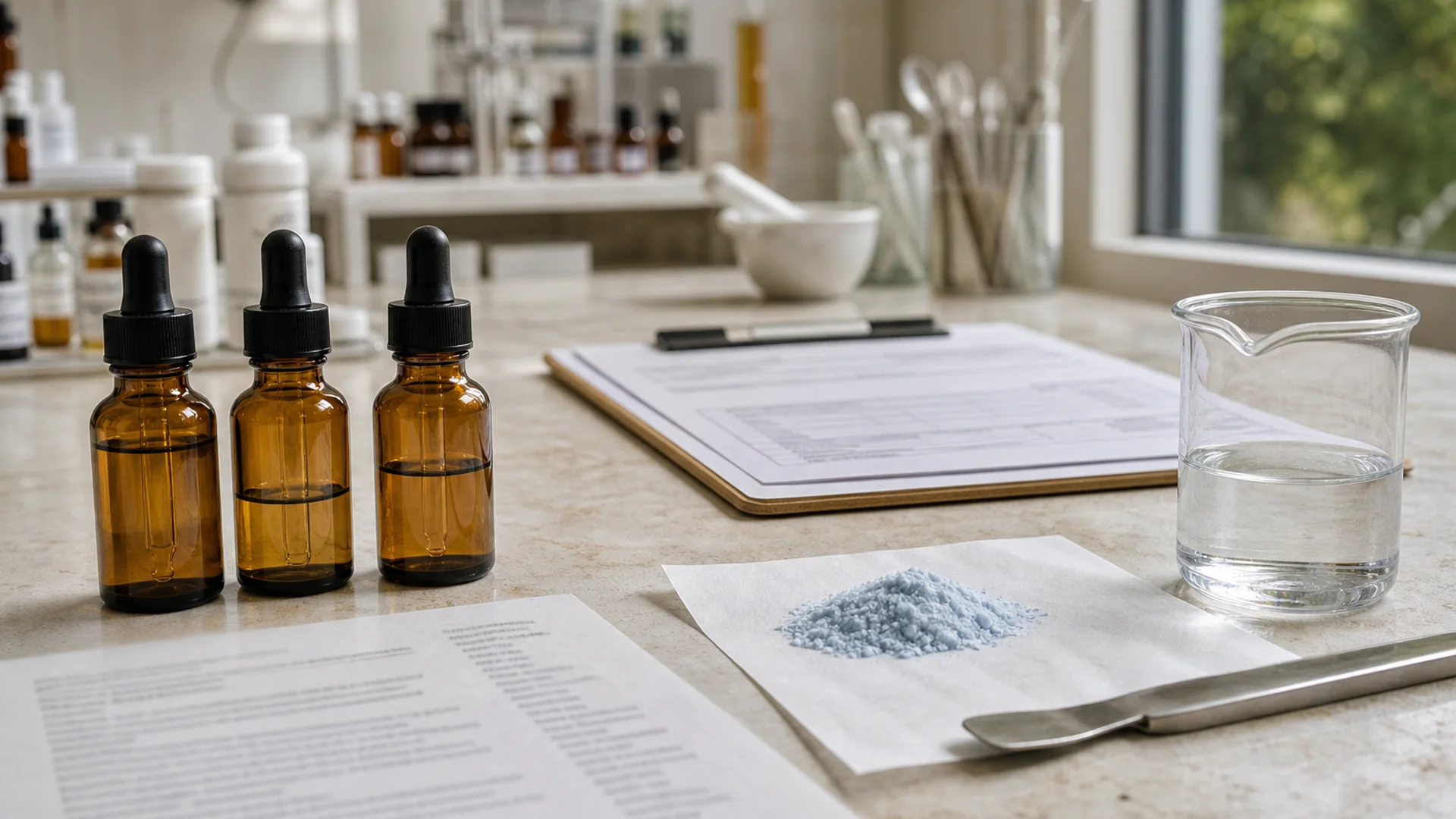
1. Four different numbers hide inside one marketing percent
Separate the layers before you argue about dose. Pure peptide is the molecule or salt on the COA. A supplier solution or blend is that peptide plus solvents, humectants, sometimes preservative. Finished-formula addition rate is how much of that commercial material you weigh into the batch. INCI declaration is the legal name list of what went into the finished cosmetic, in descending order of concentration at the time of addition. A shopper reading a front label “1% copper peptide” may be looking at any one of those layers, or at a nickname that is none of them. Browse the cosmetic peptide category as a set of documented lots, not as a single strength.
2. INCI order is a ranking, not a laboratory method
INCI lists ingredients from highest to lowest concentration as added, with the well-known exception that ingredients at or below a small threshold may be listed in any order at the end. That rule exists so labels can be written; it is not a quantitative method. Two formulas can put Copper Tripeptide-1 in a similar visual position for completely different reasons: a dilute solution added at a high percentage of the formula, or a more concentrated peptide added at a low percentage. You cannot convert “it is the fourth name” into milligrams of active. Never infer a working dose from list position.
3. “X% solution” is not automatically X% peptide
Many cosmetic peptides are sold as small-volume liquids. The pack name can include Solution, Solution B, or a millilitre size that describes the container, not the solids. Eyeseryl Solution B is a documented liquid presentation; an Argireline 5 ml pack is a small concentrate, not a finished serum use level. Read the INCI of the purchased material, the stated peptide content or dilution factor on that lot, and the recommended addition window. If the file says the liquid is a blend, the blend’s solvents become part of your water phase the moment you pour. Copying a consumer “1%” onto a different concentrate is how workshops invent a dose that the COA never supported.
4. Colour is not a concentration assay either
Cu(II) complexes are often specified as blue or blue-green in powder or solution files. That hue can be consistent with the complex being present. Intensity on a shopper’s phone, compared with a neighbour’s bottle, still cannot quantify purity or active concentration. Path length, pH, other dyes, haze, and packaging tint all move what you see. Treat colour as a lot-specification check and a troubleshooting signal, not as a substitute for chromatography. The colour article in this series covers appearance as an incoming-goods question; this page only needs one rule: do not titrate a serum with your eyes.
5. What a COA and TDS can actually establish
A serious file can confirm identity (INCI, sequence or CAS as provided), a stated assay method and result for that lot, appearance as specified, water or solvents, recommended storage, and sometimes a process window for incorporation. That is why how peptides are added to creams and serums still belongs next to the assay conversation: addition temperature and stage change what the bulk looks like, not what the COA already measured. Ask for the method. HPLC purity of a powder is not the same statement as “percent peptide in this glycerin solution,” and neither is “percent of this solution in your serum.”
6. What those documents cannot do
A COA does not prove the finished cosmetic delivered a clinical dose. It does not convert an INCI list into an assay. It does not make a marketed nickname interchangeable with another vendor’s solution. It does not replace a challenge test or a stability protocol on your chassis. If a listing omits solids content, you do not have a number to put in the dilution calculator — you have a purchasing question. Do not fill the gap with a blog percentage or with a competitor’s front label.
7. A worked distinction without inventing a working dose
A kilogram-scale GHK-Cu copper peptide is a bulk raw material whose assay, if provided, refers to that powder or specified form. A 5 ml “solution” SKU is a different commercial object: you are buying a liquid whose peptide fraction must be read from its own TDS. Putting 1% of the liquid into a serum is not the same as 1% pure Copper Tripeptide-1. Putting the powder in at a level copied from a finished-product advertisement is not the same as following that powder’s file. Write three lines on the batch sheet: what was purchased, what the file says the peptide content is, and what mass of that commercial material entered the batch. Anything else is storytelling.
8. The only percent that belongs in the brief
The useful percent is the one you can trace: commercial material × documented peptide fraction = input to the formula, caveated to that lot. INCI order, bottle colour, and a front-of-pack “1%” are not that trace. If the supplier will not document the fraction, do not invent it. If you need a consumer-facing number, it has to survive the same file, not a screenshot of someone else’s serum.