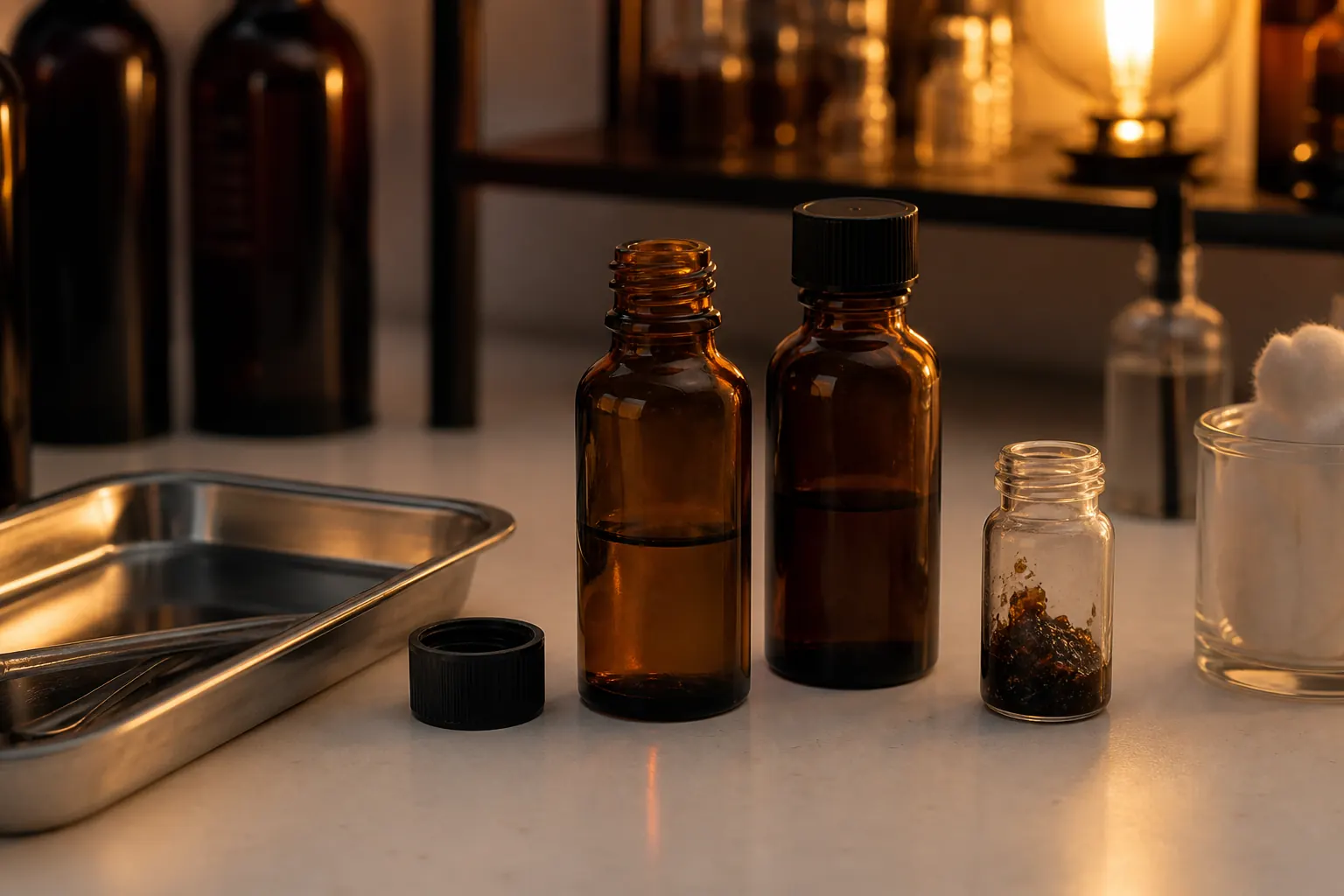
1. Clock the smell against a sealed retain, not against memory
Memory is a poor GC. Keep a sealed retain when the carton arrives. If the open workshop bottle smells harsh or resinous and the retain still matches the file, you are looking at post-opening change. Browse the essential-oil category as documented lots with appearance and storage lines — not as infinite bench droppers. If both bottles smell wrong, stop compounding and read the incoming file before you redesign the cream. A paint-like lipid odor in a carrier oil is a different article. Here the object is a volatile concentrate that was opened.
2. Lavender leftovers are a common workshop liar
Lavender essential oil is often treated as a friendly leftover because the name sounds calm. An opened 10 ml vial with a large headspace, a plastic pipette left in the neck, and a week on a sunny sill is a practical oxidation setup. The smell can go camphoraceous, flat or ‘like cleaner.’ That is not a new IFRA category and not proof you used too little. It is a reason to quarantine the open vial and to smell the retain. Do not ‘refresh’ an oxidised leftover by pouring it into a fresh bottle.
What buyers say
Buyer experience with this exact Mylo-Opt product. Educational content stays primary — this is not scientific proof.
Open the exact product page — Jojoba oil 50 mlJojoba oil helped me fade stretch marks after I had the baby.
Open the exact product page — Jojoba oil 50 mlI tell people to get the German-made jojoba oil — the quality is solid.
Open the exact product page — Lemon essential oil 10 mlI add lemon essential oil to my hair rinse.
Open the exact product page — Lemon essential oil 10 mlI love the lemon smell — I drop the essential oil into soap, creams, and shampoos.
Open the exact product page — Lemon essential oil 10 mlI'd point people with really split ends toward lemon essential oil — after a while the ends look more put together.
Open the exact product page — Lemon essential oil 10 mlBought lemon essential oil and I didn't expect to like the smell this much.
Open the exact product page — Lemon essential oil 10 mlI buy lemon essential oil pretty often and add it to my hair rinse.
Open the exact product page — Lavender essential oil 10 mlI only use lavender oil inside the cabinets: I made sachets and refresh them now and then with a couple of drops of lavender. That's my moth prevention. The lavender sachets are the favorites in the kitchen cabinets — one on every shelf.
Open the exact product page — Lavender essential oil 10 mlLavender essential oil helped me get rid of dandruff. I'm really pleased. Thank you!
Open the exact product page — Lavender essential oil 10 mlMy esthetician told me to put lavender essential oil in a hair mask.
Open the exact product page — Lavender essential oil 10 mlFor me, lavender essential oil is just a strong anti-stress thing.
Open the exact product page — Sweet orange essential oil 10 mlSmells like fresh orange. From the texture you can tell it's made from natural ingredients. You just can't tell the exact percentage mix.
Open the exact product page — Sweet orange essential oil 10 mlFinally found the smell of a freshly peeled orange! Super!!! I'd buy it again.
Open the exact product page — Sweet orange essential oil 10 mlOrange oil is really fragrant and feels right on the nose right before New Year.
3. Citrus lots oxidise too — that is not the phototoxicity page
Lemon essential oil can shift after opening: the top note flattens, the residue smells sharper or waxy. That observation is about the opened material, not about whether an expressed citrus belongs in a day cream. Do not use a darkened leftover as a phototoxicity experiment. Do not use a fresh citrus lot as proof the leftover is still fine. Two questions, two files. If the leftover has changed, it is no longer the lot you wrote into the batch record.
4. Sweet orange is not a ‘more stable lavender’
Sweet-orange essential oil is another documented 10 ml lot on the same shelf. It is not a substitute stability tutor for lavender, and it is not automatically safer because it smells like confectionery. Opened citrus leftovers polymerise and smell harsh in the same workshop climate as any other terpene-rich oil. If purchasing bought orange because lavender ‘went off,’ you changed the INCI and still have an opening protocol to write. The protocol is: cap, amber, less headspace, no metal straw left in the neck.
5. A lipid hold is not a time machine
Workshops dilute a leftover into jojoba as a lipid hold and call the problem solved. Jojoba can be a quieter place to park a small, freshly weighed premix you will use the same week. It does not rewind an already oxidised essential oil, and it does not become a preservative. If the EO already smells resinous, you are flavouring the jojoba with aldehydes. Write the open date on the EO pack. Write a use-up window that belongs to your climate, not to a blog number invented here.
6. The same physics as any air-sensitive cosmetic lot
Heat, light, metal and headspace do not become polite because the INCI is a perfume plant. Read notes on protecting actives from air as the same physics, even when the hero material is not a peptide. Do not store opened EO on the hot-plate shelf ‘so it stays pourable.’ Do not decant 10 ml into a 100 ml beaker for the afternoon. Fill smaller working vials if your process needs frequent opening. None of that replaces the supplier’s storage line on that lot.
7. What honest documentation can say
You can say the open vial no longer matches the retain. You can say the lot was not used after the odor changed. You cannot invent a peroxide number for an essential oil on this page. You cannot call an oxidised leftover ‘stronger.’ You cannot pour it into a leave-on to ‘use it up.’ Quarantine, smell the retain, and open a new pack if the file still matches. Dilution math and daylight citrus rules live on other MO-LAB pages.