1. Refuse the therapy sentence before you weigh anything
Cosmetic essential oils are fragrance and sensory materials with documented constituents. They are not a licence to write ‘treats’, ‘heals’, or ‘antimicrobial dose’ on a leave-on. If the brief arrived as medicine, stop. Browse documented essential oils as lots with INCI, botanical name, and a safety file — not as a clinic aisle. A consumer who wants a medical outcome needs a medical conversation. A formulator who wants a cream needs IFRA, the COA, and a chassis that can actually hold the oil.
2. The IFRA file is the dilution conversation
IFRA categories distinguish leave-on face, leave-on body, rinse-off, and other product types. A number that was acceptable in a soap bar is not automatically acceptable in a face oil. Allergen labelling rules are a separate legal layer from IFRA practice. Do not copy a blog ‘1% for face’ onto a different species, a different expressed-versus-distilled grade, or an oxidised leftover bottle. If the supplier will not point to a category and a maximum for that oil, you do not have a dilution — you have a gap. This page will not invent the missing number.
3. Dilution in a carrier is not solubilisation in water
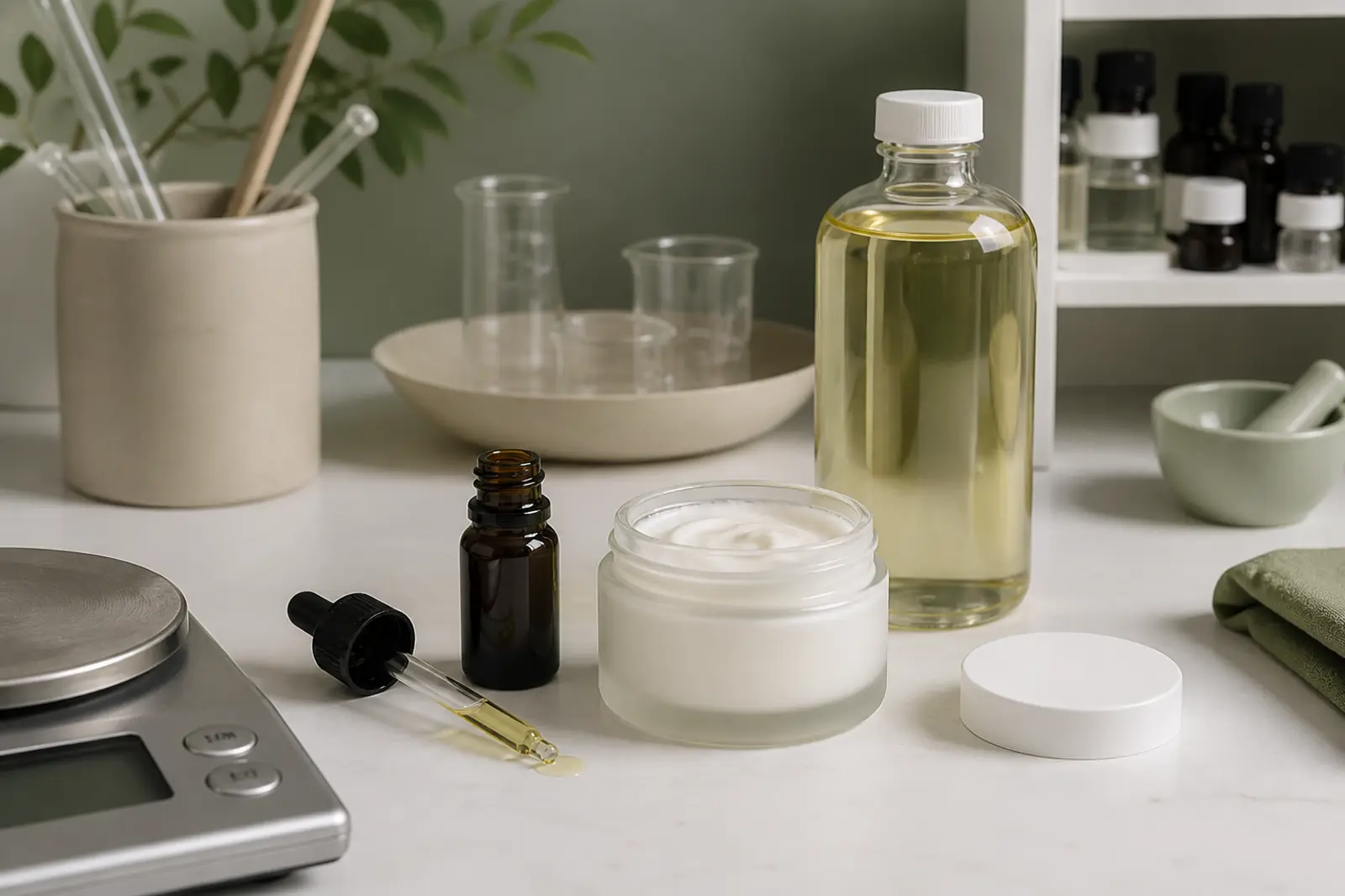
Weighing an essential oil into jojoba oil or another lipid is a homogeneous oil-in-oil mixture. That is dilution. Pushing the same oil into a hyaluronic toner is a different physical job and belongs on the Scale 2 trace-in-water guide. Do not use this page to force a cream oil into a crystal-clear essence. If the product is an anhydrous face oil, the carrier-oil phase is the whole chassis: calculate the essential oil as a fraction of that lipid, then check IFRA against the finished leave-on category — still using the file, not a folklore drop count.
What buyers say
Buyer experience with this exact Mylo-Opt product. Educational content stays primary — this is not scientific proof.
Open the exact product page — Jojoba oil 50 mlJojoba oil helped me fade stretch marks after I had the baby.
Open the exact product page — Jojoba oil 50 mlI tell people to get the German-made jojoba oil — the quality is solid.
Open the exact product page — Lavender essential oil 10 mlI only use lavender oil inside the cabinets: I made sachets and refresh them now and then with a couple of drops of lavender. That's my moth prevention. The lavender sachets are the favorites in the kitchen cabinets — one on every shelf.
Open the exact product page — Lavender essential oil 10 mlLavender essential oil helped me get rid of dandruff. I'm really pleased. Thank you!
Open the exact product page — Lavender essential oil 10 mlMy esthetician told me to put lavender essential oil in a hair mask.
Open the exact product page — Lavender essential oil 10 mlFor me, lavender essential oil is just a strong anti-stress thing.
4. Lavender is a documented oil, not a gentle exception
A lavender essential oil lot is a useful teaching SKU because it is widely treated as ‘the safe one.’ It still oxidises, still carries allergens, and still has an IFRA conversation. It is not interchangeable with a citrus expressed oil for phototoxicity, and it is not a preservative. Read the botanical name and the distillation note on that pack. A 10 ml bottle is a container size, not a use level. Calculate mass into the batch; do not count drops from a different orifice.
5. In a cream, the oil is a late, small, interfacial passenger
Adding essential oil on cool-down can stress a barely covered emulsion the same way a late ester can. That is an architecture problem, not proof that ‘natural oils reject the cream.’ Design the lipid load with cream emulsifiers that were chosen for the full oil list, then add the volatile fraction when the sheet allows. If the cream splits only after the essential oil, run a retain without it before you replace the emulsifier. Fragrance load also changes preservative and sensory behaviour; appearance is not a challenge test.
6. Oxidised essential oil is a different material
Old, heat-stressed, or half-empty EO bottles form peroxides and new allergens. Diluting an oxidised lot does not make it ‘mild.’ Date the bottle, keep it cool and dark, and do not top up a workshop dropper from a bulk that has stood open. If the odor has gone sharp or ‘off,’ stop using it in leave-on face products. The IFRA discussion assumes a material that still matches its specification.
7. Copy that survives a file check
You can talk about scent, ritual, and the documented INCI. You cannot promise treatment of disease, replacement of a drug, or a universal drop protocol. If marketing needs a number, it has to come from the IFRA category and the lot file after legal review. If they need a water-clear toner with a hint of scent, that is the other guide. If they need a cream, weigh the oil, name the carrier, and keep therapy off the pack.