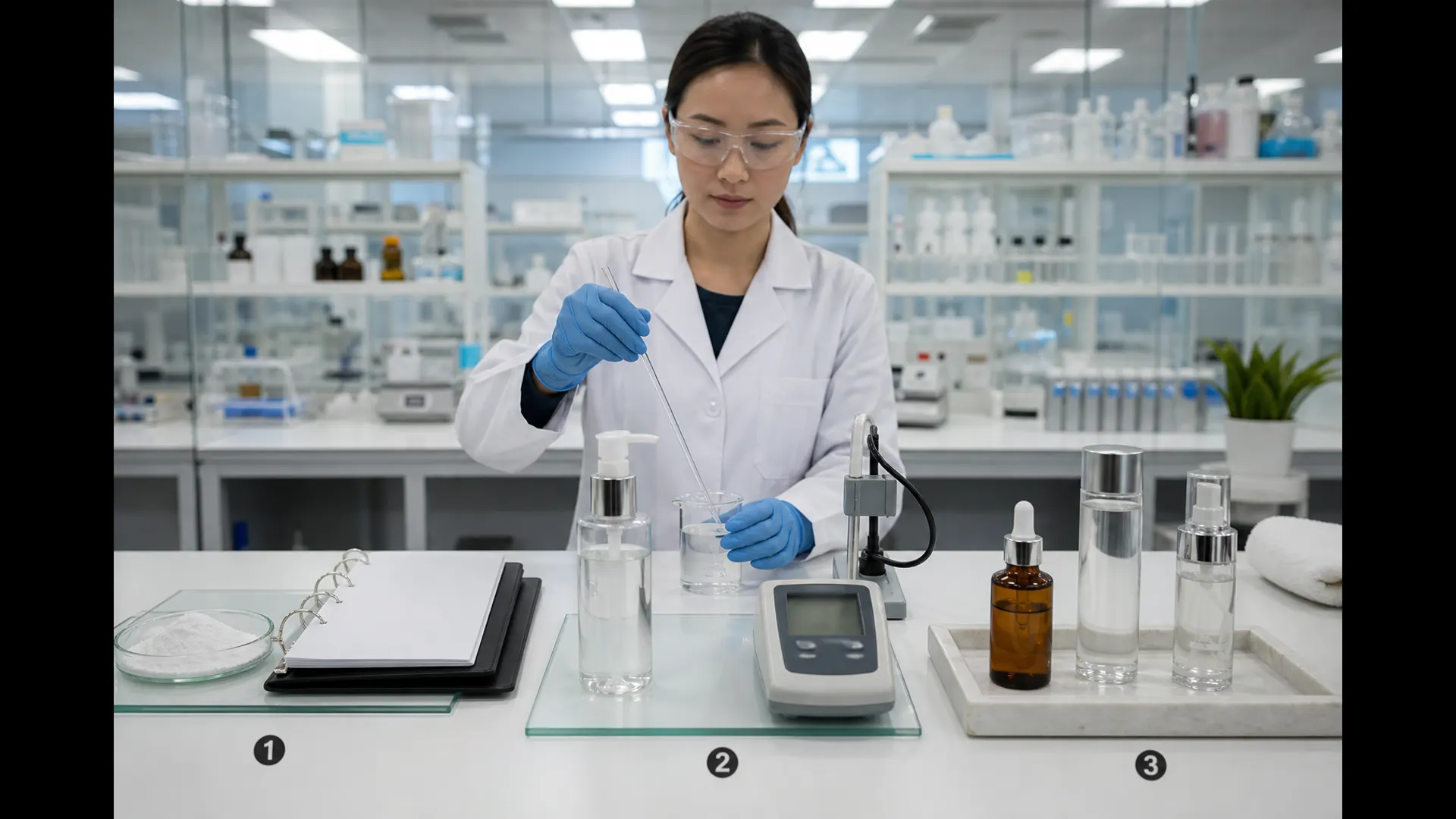
1. Name which of the three problems you actually have
Raw-material stability asks: will this lot survive in this bulk, at this pH, with these solvents, until the expiry you print? Finished-product compatibility asks: after cool-down extras, does the serum still look and feel like the chassis you approved? Consumer routine layering asks: does this person put two finished products on skin minutes apart? Those are not the same experiment. A peptide that hydrolyses in a pH 2.8 L-ascorbic tank over months can still sit beside a separate acid toner in a bathroom without “cancelling” on contact in the way internet posts imply.
2. “Peptide” is a filing cabinet, not a molecule
Acetyl Hexapeptide-8 concentrate, palmitoylated signal peptides, and copper tripeptide GHK-Cu do not share one hydrolysis curve. Palmitoyl chains change partitioning. Copper coordination is a metal-binding story as much as an amide-bond story. Forced-degradation work on GHK-Cu has even shown oxidative stress to be a harsher laboratory insult than simple acid in some setups — which is a reminder to read the lot, not the meme. Browse peptide raw materials as individual files: INCI, counter-ions, recommended pH, chelator notes, and whether the supplier tested the peptide next to organic acids.
3. There is no universal cliff at pH 4
Amide bonds can hydrolyse faster as acidity and heat rise. That is chemistry, not a law that every cosmetic peptide is instantly “denatured” below pH 4 at room temperature in a cream. Denaturation is also the wrong word for most of these actives: they are not folded globular enzymes in the laundry-detergent sense. What you may see is slower cleavage, deamidation, colour shift, or a copper complex that no longer matches the COA. The number that matters is the window on the TDS/COA in front of you, confirmed in your full formula — including preservative acids, which also move pH.
4. Vitamin C is several ingredients wearing one nickname
L-ascorbic acid is often held near pH 2.5–3.5 in water to stay protonated. That chassis is a hostile neighbourhood for many peptides if you insist on one pot. Magnesium ascorbyl phosphate is a different brief: a phosphate derivative typically handled closer to skin-range pH, which is why it shows up in peptide-adjacent waters. Layering a finished MAP serum over a finished peptide serum is still a routine question (sting, pH at the surface, wait time), not automatic annihilation. Combining both in one bulk is a stability protocol, not a TikTok rule.
5. AHAs in the same jar vs AHAs in the same evening
Glycolic or lactic acid at leave-on exfoliant pH in the same aqueous phase as a fragile peptide is a formulation choice you validate or you split into two SKUs. Using an acid toner at night and a peptide moisturiser in the morning is a use pattern. The skin surface is not a beaker at equilibrium for eight hours of mixing. Irritation from stacking actives is a real consumer problem; “the peptide vanished because pH was 3.8 for ten minutes” is usually an overclaim. If sting or barrier tightness appears, stop stacking — that is tolerability, not a proof of hydrolysis.
6. Copper peptides deserve their own column, not a copied rule
GHK-Cu is hydrophilic, coloured, and sensitive to chelators and redox partners in ways Argireline is not. Strong EDTA-like systems, aggressive reducing ascorbic solutions, and very low pH vehicles are reasonable items to screen. They are not a reason to tell every customer that “all peptides die with vitamin C.” Incorporation notes for creams and serums still apply: cool-down, documented pH, no mystery premixes. Preservation of peptide cosmetics is part of the same environment: organic acids in the preservative can move the number you thought was “peptide-safe.”
7. A workflow that keeps the three questions separate
In the lab: challenge the specific peptide in the specific bulk, pull pH and appearance over time, and do not import a pH-4 slogan from a different INCI. In the factory: lock the finished pH against both the peptide sheet and the preservative sheet. In the bathroom: if two products irritate together, separate them by time of day before you throw away the peptide. Peptides are not cancelled by the word “acid.” They are constrained by the lot, the formula, and the way the finished products are actually used.