1. This is not the electrolyte-thinning article
Open carbomer salt shock when a finished acrylate gel collapsed the moment ions arrived. Open the viscosity tree when you do not yet know whether hydration, pH, solvent or overnight bulk is the culprit. Open thickener-for-serum when the family is still a shopping decision. Stay here when the beaker never stood. Browse gel formers as grades with wetting and neutralization lines — not as a second bag of the same powder that already failed to hydrate.
2. Name the slurry before you name the polymer
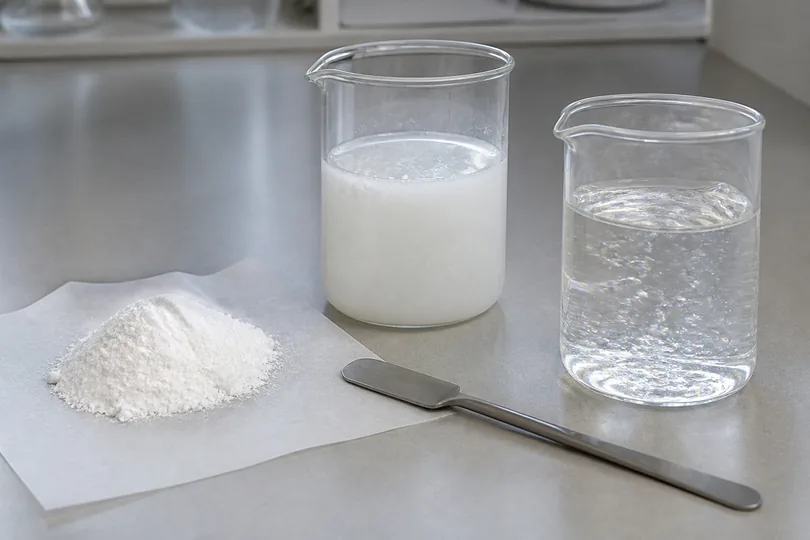
Photograph the mass under the same light. Fish-eyes and dry crumbs are incomplete wetting. A uniformly thin, slightly opalescent liquor can be wet polymer that was never neutralized. A stringy, cloudy mass after you ‘added more’ is often more solids in the same unfinished state. Carbomer as a named lot is the object you weigh; it is not a diagnosis. If the retain powder looks normal and the process skipped a soak or a slow alkali, the drum is not the first suspect.
What buyers say
Buyer experience with this exact Mylo-Opt product. Educational content stays primary — this is not scientific proof.
Open the exact product page — Carbomer 1 kgBought carbomer to make a shower gel. Followed the instructions. The carbomer thickened the water phase nicely. I'd shop here again.
Open the exact product page — Xanthan gum 1 kgShampoo recipe: I cool a soap-nut decoction (around 300 ml), add a teaspoon of baking soda, dissolve essential oils in polysorbate 20 (I like citrus and mint — hair stays clean longer), mix that into the decoction and add a pinch of xanthan gum. I whip it with a regular immersion blender, not a little cream mixer. The longer I blend, the thicker the shampoo. It keeps in the fridge for two weeks.
3. Local alkali is a crater, not a pH target
Dumping a concentrated neutralizer into one corner of the beaker creates a high-pH pocket and a still-acid slurry a few centimetres away. The meter can later read ‘fine’ after mixing while the polymer never saw a uniform environment. Slow addition, enough water around the alkali, and a retained control of the same grade are the comparison — not a blog percentage. Do not invent a neutralization band here. That band lives on the grade file.
4. Xanthan is a different process, not a moral upgrade
Xanthan gum is the honest fork when the brief already knows ions will arrive and you do not want an acrylate story. It is not ‘natural, therefore it will stand without a protocol.’ It wants its own wetting, its own shear, and it can string if you starve the hydration. Switching bags because the carbomer slurry looked embarrassing does not skip the process page. Two families, two clocks. Do not treat xanthan as a silent drop-in for a neutralization you never finished.
5. Clock when the body appeared — or that it never did
If viscosity appeared only after a slow alkali and a rest, you were on this page and you finished the job. If viscosity appeared and then died when a salted concentrate arrived, leave this URL and open the salt-shock article. If nothing ever stood, do not write ‘electrolytes’ into the batch record to sound technical. Write: wetting incomplete, or neutralization never uniform. That sentence saves the next bag of polymer.
6. What you can write without inventing a number
You can say the slurry never matched the retain gel you keep for that grade. You can say the alkali was added too fast or in too little water. You cannot publish a ‘safe’ carbomer percent, a magic pH, or a claim that xanthan always survives salts. Those numbers stay on the files you actually opened. The shopping list for serum thickeners and the ion-collapse article remain the neighbouring URLs, not twins of this process clock.