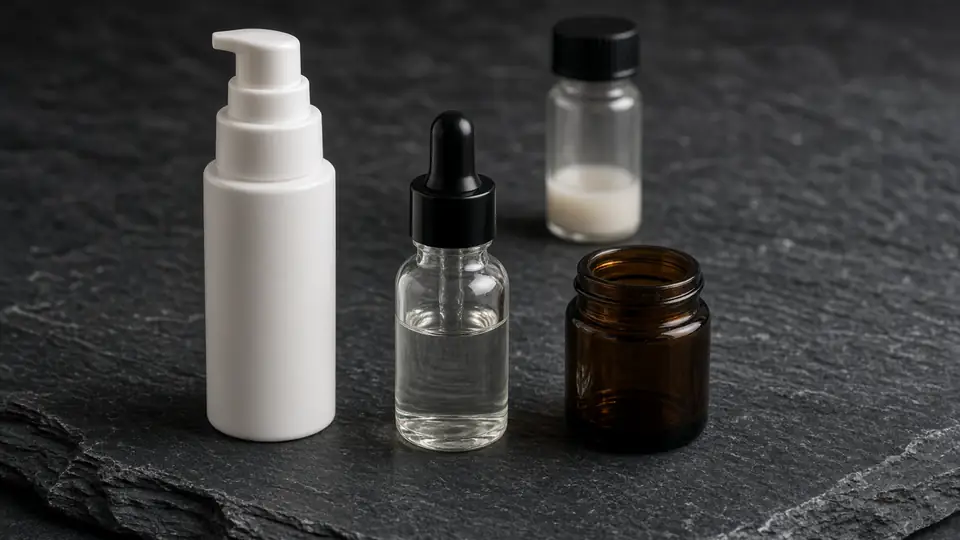
1. Exposure reduction is a real job — and a small one
Headspace, repeated air exchange, and a sunlit window can move colour and odour on documented peptide lots and on oxidation-prone waters. Choosing a pump, a dropper, or a jar is part of that exposure story. Write the closure you will actually fill. Do not write ‘airless, therefore done.’ The pack is one line in the file. It is not the file.
2. A tighter pack is not a preservative system
Less finger-dipping can lower the insult. It does not name a preservative, a dose, a pH window, or a challenge plan. Browse preservatives and antioxidants as documented systems, not as a vibe that ‘airless is cleaner.’ Read preservation notes written for peptide waters for the water you actually made. An empty airless bought because a moodboard said ‘clinical’ still needs a real system in the formula.
3. Opaque plastic does not fix pH or a neighbour conflict
A copper complex, an acid, a chelator, or a vitamin derivative can still disagree in the dark. MAP vitamin C is a useful example: a light-blocking pack may slow a colour walk and still leave you with a pH or salt fight you never measured. If the beaker already crashed, the pump will not uncrash it. If the beaker looked fine, the filled unit can still drift — that is why you keep a retain of what you filled, not only of what you stirred.
4. The pack does not prove body or identity
A pump that sputters, a dropper that doses 0.4 ml when the label implied 1 ml, a gel that thins after the third concentrate — none of those are solved by UV film. Ask the gel formers whether the ionic and solvent tax of this water was designed. Ask the batch sheet whether the object you weighed was the object the brief named. Packaging art cannot recover a missing identity line.
5. Dropper, airless, jar: different exposure, same missing proofs
A jar invites fingers. A dropper invites headspace and a wet orifice. An airless pump invites a different failure: stalled pistons, suck-back, and a mood that ‘no air’ means ‘no work left.’ Compare those closures as exposure tools. Then run the same chemistry and micro questions on each. Notes on protecting actives from light and air are a destination for that exposure conversation — not a substitute for your filled-unit protocol.
6. What a filled-product protocol actually writes
Name the formula, the lot of each raw, the pack component, the fill volume, the headspace, the storage condition, and what you will score (appearance, pH, viscosity, odour, dispenser function). Hold a retain in that pack. A beaker on the bench is not that retain. You may say the pack was chosen to reduce air or light exchange. You may not say the pack proved stability, preservation, compatibility, or dose.